Production from two shifts upward
Particularly attractive where compressed-air and heat demand is consistently or regularly high.
Concept design, engineering and technical implementation of DHKW plants and energy-efficient system solutions for industrial applications.
A DHKW replaces electrically driven compressed-air generation with a directly driven screw compressor powered by a gas, biogas, or prospectively hydrogen-capable engine. The resulting waste heat is also put to productive use.
A compact, turbocharged gas engine directly drives a screw compressor. This generates compressed air mechanically from natural gas or biogas rather than electrically – hydrogen is a future option.
A compact, turbocharged natural gas engine built for maximum efficiency and power output (e.g. 2G Energy 406 natural gas, 248 kWmech) directly drives a screw compressor (e.g. Aerzener VMX). This generates, for example, 40 m³/min of compressed air at 8 bar(g). At the same time, usable heat is available for heating or process heat.
Using a typical design as an example, the following diagram shows how a single fuel input simultaneously produces compressed air and multiple stages of usable heat.
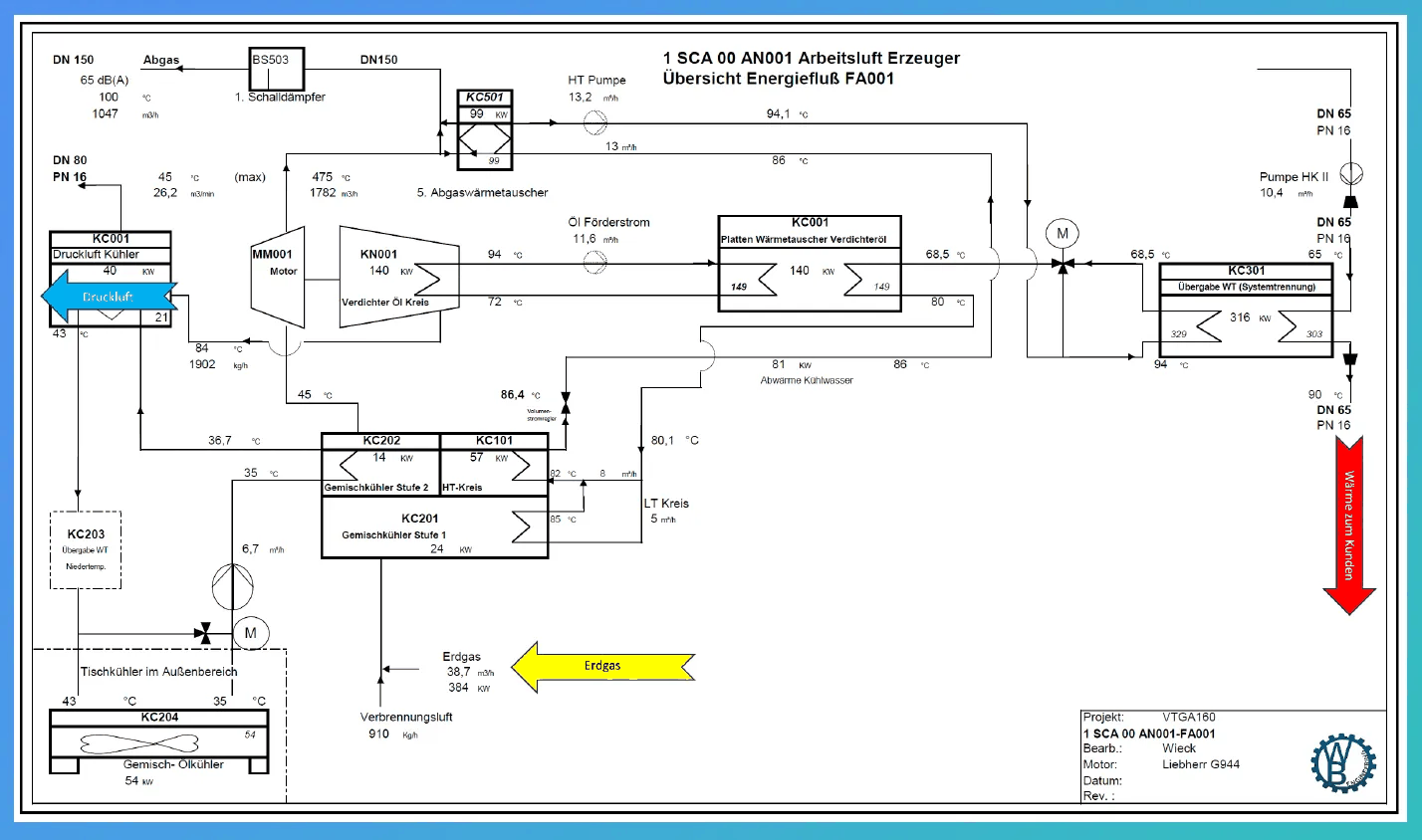
Example energy flow overview: the gas engine mechanically drives the compressor to generate compressed air, while heat from engine cooling, compressor oil, exhaust gas and compressed-air cooling is recovered across several heat exchanger stages and supplied to the customer at a usable temperature level.
Want to reduce energy costs and CO₂ in your compressed-air generation?
Then generate compressed air with our DHKW from natural gas or biogas – and in future hydrogen – instead of electricity, and use the waste heat for heating or process heat as well.
The economic benefit is greatest where compressed-air demand is high, operating hours are long, and there is a significant gap between electricity and gas prices.
Particularly attractive where compressed-air and heat demand is consistently or regularly high.
Advantageous for companies that are already large-scale natural gas consumers or can use alternative fuels.
With high operating hours, a DHKW can significantly reduce operating costs compared with electrical compressed-air generation.
Ideal when replacing an old compressor or expanding an existing compressed-air station.
This is exactly where the DHKW comes in: electrical compressor output is reduced or replaced, while usable heat is generated at the same time. Several savings levers take effect simultaneously.
In conventional compressed-air generation, electrical energy powers the compressors and much of the resulting heat goes unused. A DHKW generates compressed air mechanically via a gas or biogas engine and also makes the waste heat usable.
The biggest lever is reducing electrical compressor work. The higher the electricity price, operating hours and compressed-air demand, the stronger the economic case for a DHKW.
Heat from the engine, exhaust and compressed-air cooling can be put to use. This turns compressed-air generation into a combined energy system.
A DHKW is especially worthwhile for multi-shift operation, continuous base load, or planned expansions of compressed-air supply.
Besides natural gas, depending on the engine concept, biogas or, prospectively, hydrogen-capable solutions can also play a role.
We assess compressed-air demand, heat demand, operating hours, energy prices and installation conditions, and determine whether a DHKW makes technical and economic sense.
All configurations shown here are in operation at customer sites – depending on compressed-air demand, control behaviour and installation site, from fixed-speed units to containerised outdoor installation.
Configuration for high compressed-air output, e.g. 40 m³/min, with intake control.
Fixed-speed design for high efficiency and a robust base load.
Variable delivery volume via speed control for more flexible load profiles.
Suitable for outdoor installation and modular integration on site.
For a DHKW, early technical assessment is decisive: compressed-air profile, heat profile, operating hours, fuel costs, installation site and integration with existing systems.
Compressed-air demand, heat demand, run times, energy prices and existing infrastructure.
Engine, compressor, heat utilisation, controls, installation site and interfaces.
Engineering, manufacturing, assembly, integration and commissioning.
Support, maintenance, optimisation and technical assistance during ongoing operation.
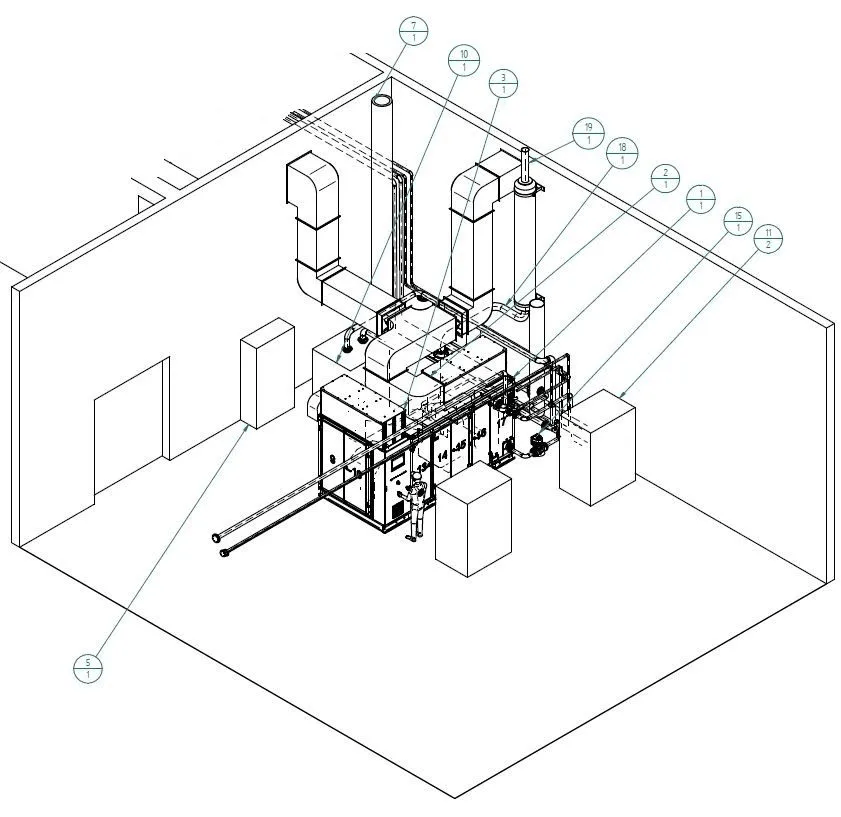
Example installation planning: this shows how a DHKW, including exhaust routing, silencer and connections, is technically integrated into the existing plant room – including all relevant interfaces marked for assembly and commissioning.
Our processes and services are audited by independent bodies – a reliable basis for your projects.
Our quality management system is certified to ISO 9001:2015. Scope: design, development, assembly, commissioning, maintenance and operation of machinery.
View ISO certificateWB Engineering is certified by TÜV SÜD as a specialist company according to § 62 AwSV (WHG). This qualification supports legally compliant work on systems involving water-polluting substances and provides additional safety, quality and legal certainty for industrial, energy and plant engineering projects.
View WHG certificate